


UN HOUSE IN MOLDOVA: DIVERSITY IN ACTION
- IHRC NEWSROOM
- May 15, 2019
- 6 min read

The UN in Moldova is winning the battle against lack of diversity by hiring interns from under-represented minorities and making UN House fully accessible to people with physical disabilities.

MAY 14TH, 2019
CHISINAU, Moldova—When visiting UN House in Moldova, the first thing you’ll notice is the standard business card: it is embossed in Braille.
A quick glance then reveals a wide elevator and spacious lavatories, bright yellow tactile strips along the building’s exterior and stickers to make glass doors easily visible. Looking more closely, you’ll spot a breastfeeding room, tucked around the corner from the main entrance.
In this city of uneven streets and abruptly ending sidewalks, a fully accessible building comes as a surprise.
A LACK OF DIVERSITY
It all started when an internal survey in 2012 revealed a surprising lack of diversity among United Nations staff in Moldova. A follow-up in 2015 yielded similar results.
“There were no persons with disabilities, no Roma, a poor ethno-linguistic mix, and hostility to sexual minorities,” said Veaceslav Balan, former National Coordinator of UN Human Rights in Moldova.
Nor was the main UN building accessible to people with disabilities.
When Xenia Siminciuc – who is now a Consultant for Diversity, Inclusion and Equality at UN Human Rights in Moldova – first joined the organization, she kept bumping into doors because she had only 5% vision. And when the UN Special Rapporteur on the Rights of People with Disabilities arrived in a wheelchair for a visit, she was confronted with stairs to reach the upper floors.
These wake-up calls led the UN to a surprising realisation: the organization was preaching, but not practising.
It was time to lead by example.
FIGHTING BIASES
Diversity has long been a thorny issue in this small country. A few years ago, a nation-wide study revealed negative attitudes towards some minority groups were widespread, despite robust equality laws which, as can be the case with laws, looked better on paper than in practice.
For the UN to provide any kind of leadership, it would first have to sort out its own internal biases. It decided to launch a diversity initiative that would not only improve things within the walls of UN House, but simultaneously promote change in Moldovan society.
The first step was to make UN House accessible to all.
An entire team – a UN Diversity Task Force – was pulled together, with the Resident Coordinator’s office providing financial management and UN Human Rights providing lead experts and advisors.
Rather than impose general views and perhaps perpetuate the very biases they were targeting, the task force helped organize a ‘user safari’ in which persons with physical and sensorial impairments tested UN House’s accessibility. They found it wanting.
Over time, the task force made many recommendations and, bit by bit, UN House became more welcoming – ramps, rails, signs, colours and textures were modified, making it easier for people with disabilities to get around.
In addition to physical changes within the building, work itself became more accessible. Larger fonts were used on computers and the UN website was upgraded, allowing access to new and helpful technologies.
Accessible communication became the norm and the UN added Russian to its languages, along with Romanian (the majority language) and English. A partnership with a web training NGO led to developing a new website, accessibility.md, to promote awareness around accessibility in Moldova.
And there were small everyday changes that made life easier, such as brightly coloured and contrasting dishes in the kitchen or larger signs on doors.

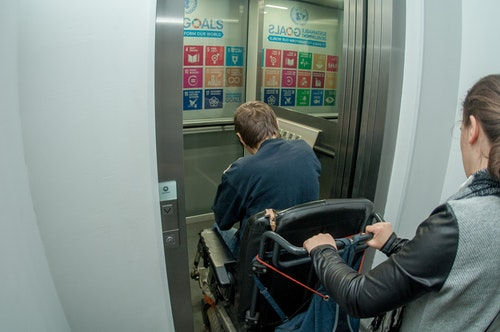

UN House became more welcoming – ramps, rails, signs, colours and textures were modified, making it easier for people with disabilities to get around.
A DIFFERENT KIND OF INTERNSHIP
Despite the radical changes visible at UN House, one area still lacked diversity: staff.
“We didn’t understand why minority groups were so passive when applying for UN jobs,” said Balan of UN Human Rights.
Part of the explanation could be found in a society layered with stereotypes, inherited perceptions about disability and a general wariness. The remaining reticence came from within the UN itself, where unnecessary regulations and cumbersome procedures made hiring marginalised groups difficult.
“It is kind of a Catch-22 situation,” said Dafina Gercheva, the UN’s Resident Coordinator in Moldova. “Anyone coming out of university and seeking a job needs to have at least a bit of experience, but the only way they can get that experience is by applying and getting a job.”
Yet the UN system discouraged many minority job-seekers: English was universally required, even for jobs where it would never be used; people with disabilities found UN forms complicated to fill; should they ever get as far as an interview, they would find the building inaccessible or difficult to navigate; and of course, they would have to fight existing internal biases.
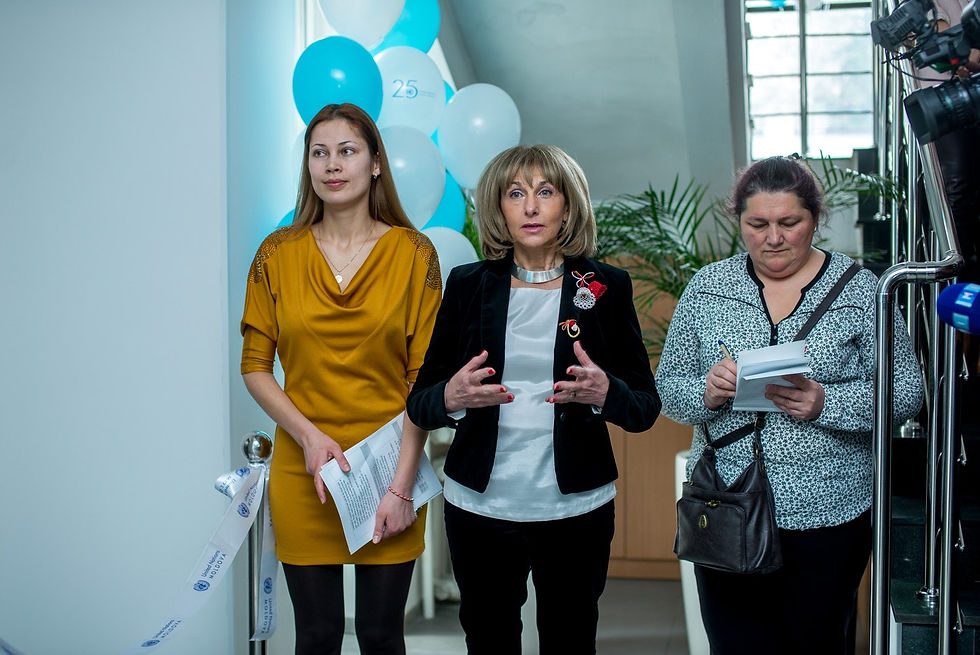
Dafina Gercheva (centre), former UN Resident Coordinator in Moldova
Beating back these difficulties one at a time, the task force developed an internship programme that would end up making minority group status an advantage.
To find candidates, civil society organizations working with vulnerable groups were encouraged to spread the word, especially among those most susceptible to human rights violations and therefore most under-represented in the labour market – people with disabilities, of course, but also members of the LGBTI community, people living with HIV, Roma and other ethno-linguistic minorities.
UN Human Rights led the UN-wide effort by helping draft all the job-related documents, promoting the competitive search, coordinating the interviews, organizing a launch event and monitoring success.
It was a gamble, since the traditionally rigid UN rules had to be massaged. A courageous push by those who believed in the initiative backed by strong support from the Resident Coordinator made success possible.
“It was a win-win situation,” said Balan. “Many of our staff embraced this diversity and even among the more conservative, who initially voiced concerns, there was an openness to change. UN staff now notice how inaccessible the city is and has an increased general awareness of these issues.”
Finally, from 30 or so applicants, the first 12 interns were hired in 2016. Each belonged to a group that was under-represented within the UN.
Not only did these internships diversify the UN workforce – they changed lives forever.

Veaceslav Balan, former National Coordinator of UN Human Rights in Moldova.
“Now I say I will fight for my rights,” said Ecaterina Sochirca, one of the interns hired by UN Human Rights. “This internship gave me the power to follow my dream: a stable and interesting job.” From under-represented minority, Sochirca has herself become an agent of change.
Sochirca has a visual impairment and comes from a small village in Transnistria, Moldova’s breakaway region. She faced much stigma and discrimination while looking for a job after completing a Master’s degree in international relations. In addition to people with disabilities, her cohort included young men and women who were living with HIV, who were in same-sex partnerships, or who belonged to stigmatised ethnic or linguistic groups.
In a country where opportunities are scarce, access is difficult and mortality and migration high, dedicated and professional young interns are an untapped potential for economic growth.
WORKING BEYOND THE UN
With UN House now accessible and the workforce increasingly diverse, it was time to tackle the UN’s partners. The UN began to inform its venues and vendors that accessibility would become a criterion when bidding for contracts.
Procurement rules were changed to stipulate that vendors and venues required at least minimum accessibility.
By 2017 accessibility became compulsory and in 2018, a consultant visited all venues and compiled a list. This had huge impact as vendors wanting to work with the UN scrambled to adjust. These days, if you want to rent out your venue for a UN event, it has to be accessible.
The circle has widened beyond vendors and several institutions and businesses including government ministries, courts, NGOs and media organizations are following the UN’s lead, making their own premises accessible and their staff diverse.
A CHALLENGING ENVIRONMENT
While the initiative was a sound success, getting there was anything but easy.
Some challenges were physical, like finding the right elevator in Moldova or locating tactile paving strips, which eventually were imported from Kiev.
Other challenges were political, such as convincing local authorities to approve an elevator in what was a building of historical significance.
Yet others were social and cultural, involving changes in attitude and awareness among those who had difficulty grasping the need for any of this at all.
“This is a long process and things don’t happen overnight,” said the UN’s Gercheva. “We still have not reached the critical mass required in order to achieve sustainability and have all this come naturally.”
Obstacles do remain. Not every UN premise outside UN House is accessible yet, nor have all administrative roadblocks – such as centralised policies or language use – been overcome.
But these barriers are slowly being dismantled and it’s only a question of time.
Given the cost of the endeavour, some wonder why diversity isn’t the norm everywhere. Other than major physical enhancements to make premises accessible, such as building an elevator where there was none, the cost of diversifying the workforce and one-time adaptation of premises is low. In the case of the UN in Moldova, the only ongoing cost is that of a part-time salary and a small training budget.
What has really changed are the lives of those involved in the initiative.
“I am a changed person, and my dreams have come true,” said Xenia Siminciuc. “Before, people here didn’t believe people with disabilities could make a significant contribution. My dream was to show them that wasn’t true.”
As she hands out her business card, she runs her fingers along its raised dots of Braille.
Today, not only does UN House stand as a showcase for other UN properties worldwide, but it is helping fuel change in the Moldovan capital, leading by example.
As a workplace, it is now every bit as diverse as it tells others they should be.


Comments